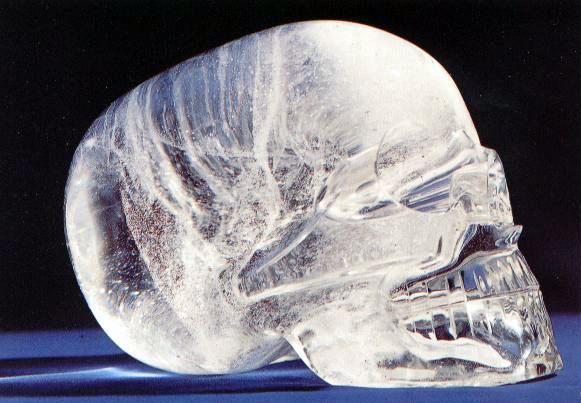
Crystal skulls are a metaphor that reality is a consciousness hologram through which we experience virtually. Many of the s=crystal skulls are tools that awaken human consciousness, referenced by the human brain design of the crystal and the metaphoric eyes.
A crystal skull is a model of a human skull generally made out of quartz crystal, but not always, as in the case of Chinese jade skulls. Crystal skulls vary in size from a few inches to the size of a human head, or bigger. The age of a skull can be equated not so much to the year it was carved, or the place of origin, but to the age of the crystal from which it was created, some crystals being thousands of years old, while others are more contemporary. Crystal skulls are most often associated with ancient Mesoamerican cultures, especially the Maya which takes us to the Mayan Long Calendar and related prophecies.
Humanity has always been on an esoteric journey to solve the mysteries of its creation linked to people and objects that allegedly contain higher powers, or can enhance those of the questor. Technology and the Internet help move consciousness to that place, with great precession, as if it was all part of a cosmic plan. We can sense the truth, soon to be revealed, about who we are and why we are here.
The enigmatic crystal skulls have become another tool of divination to that end, crystals sometimes been thought of as having magical powers, as well as transmitters and receivers of energy.
If you are reading this file, your soul is searching, in these prophetic times, for answers to the great mysteries of life ... death ... and rebirth.
Many crystal skulls are designed at specific angles representing a union of sacred geometry and the nature of the quartz crystal used.
In metaphysics, crystal skulls are used for ceremonial work, healing, energy work, and enhancing one's psychic abilities. Used for healing, we go to themes of self awareness and creating balance to opening psychic abilities to be able to understand the nature of human creation and evolution.
Holding an object to exchange energies and/or receive messages with it, is called psychometry. To find messages while look at the inclusions within a quartz crystal, or crystal skull, is a form of divination called Scrying.
There are countless hypotheses that the crystal skulls are the legacy of some higher intelligence or ancient astronauts who seeded the human race.
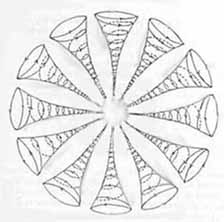
There are many theories linked to the Principle of 12 around 1 or 13 = 4 (time, closure):
* Crystal skull grid matrix
* Zodiac
* Clock
* Jesus and his disciples
* Tribes of Israel
* King Arthur and 12 knights of the round table
* Core group of 12 creator gods or aliens from who everything in this reality stems
13 takes us to the closure of our biogenetic experiment at this level of reality, created in linear time to understand emotions. December 21, 2012 is allegedly the time for the evolution of consciousness foretold in all prophecies, when humanity awakens and souls return to 'source' as this program closes.
In third dimension, there will always be 12 or 3. Taken further we have the Fibonacci Sequence, published in 1202, and further on to the patterns of sacred geometry that explain the movement of human consciousness through time.
There are allegedly 12 pyramids or 12 portals, or 12 major power points on the Earth grid that are strategically placed and will activate when consciousness reaches Zero Point - reversed Fibonacci to zero. Some also see 12 UFO's buried in the beginning, that will rise at the end of time.
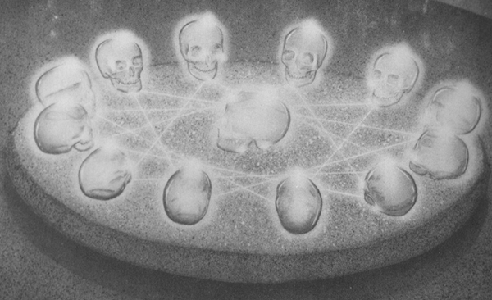
There are many theories about 13 crystals skulls that will come together soon, as human consciousness remembers its soul's purpose and all evolves in the alchemy of time.
* 13 crystal skulls were left behind by a sophisticated Hollow Earth society who left thirteen "master skulls" which contain around the planet the history of these people, their relationship to our creation, and the future of humanity.
* 13 crystal skulls were left behind thousands of years ago, by ancient Mayan elders, to be found by future generations. These skulls are containers of great knowledge and wisdom holding information about the history of the planet, the evolution of mankind, and above all, our purpose on this Earth and our future destiny. The legend says that one day, at a time of great crises, all of the 13 crystal skulls will be discovered and reunited. When that time comes the information will be divulged to humanity, who will be ready to understand it.
* 13 life-size crystal skulls scattered throughout the planet that will one day be brought together, forming a grid matrix that will allow human consciousness to evolve and return to its natural state of light. Some of the skulls are allegedly in the hands of indigenous people, shaman perhaps, who are custodians of the artifacts, while other crystal skulls remain in the hands of those who are not yet aware of their importance.
* 12 people, along with their crystal skulls, will be guided to a specific place, when the time is right, most likely the Yucatan. No one seems to know exactly when or where that will, though the time feels soon. The location of the 13th skull is most likely unknown at this time. Theories abound from a link to extraterrestrials, to buried beneath the ground, to it will manifest when time is resequenced, to being hidden by ancient Mayan elders. When placed together, the crystal skulls will form a grid matrix (reality is a consciousness holographic matrix) aligned with the 13th skull, allowing human consciousness to ascend (return) to its natural state of being, light.
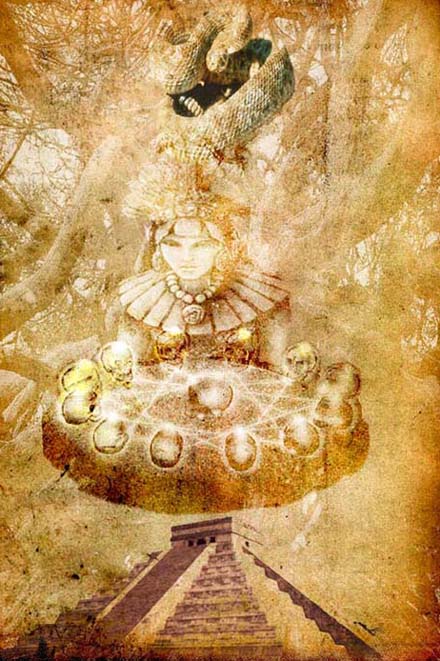
The snake in this image references the spiraling movement of human consciousness and DNA -- Reptilian Connections -- Sumerian Gods creating a biogenetic experiment.
Crystal skulls are primarily linked to the ancient Mayans as so many skulls are found in Mesoamerica. The Maya take us to Quetzalcoatl and the Mayan Calendar prophecy of December 21, 2102 as an end time date for the programmed reality in which we experience at this level of conscious awareness.
The Mayan Calendar
December 21, 2012: The Long Count calendar used by the Maya civilization of pre-Columbian Mesoamerica completes its thirteenth b'ak'tun cycle since the calendar's mythical starting point (equivalent to 3114 BCE August 11 in the proleptic Gregorian calendar, according to the "GMT-correlation" JDN= 584283).
The Long Count b'ak'tun date of this starting point (13.0.0.0.0.0) (13=4) is repeated, for the first time in a span of approximately 5,125 (13=4) solar years.
The significance of this period-ending to the pre-Columbian Maya themselves is unclear, and there is only a single known but incomplete inscription (Tortuguero Stela 6) which records this date. However, it is conjectured that this may represent in the Maya belief system a transition from the current Creation world into the next. A number of modern synchretisms and "New Age" theories co-opt this period-ending into their own speculations on the meaning of this "ending" of a Maya calendar cycle. The December solstice for 2012 also occurs on this day; to the majority of Mayanist scholars this is seen as no more than a coincidence, and the Maya did not deliberately devise their calendar so that this period would end on a solstice point.
Mitchell-Hedges Skull
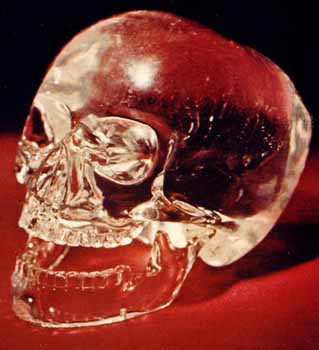
The most widely celebrated and mysterious crystal skull is the Mitchell-Hedges Skull, for at least two reasons. First, it is very similar in form to an actual human skull, even featuring a fitted removable jawbone. Most known crystal skulls are of a more stylized structure, often with unrealistic features and teeth that are simply etched onto a single skull piece. Second, it is impossible to say how the Mitchell-Hedges skull was constructed. From a technical standpoint, it appears to be an impossible object which today's most talented sculptors and engineers would be unable to duplicate. The discovery of the Mitchell-Hedges crystal skull, sometimes referred to as the "Skull of Doom", is a controversial matter, and reads like a sci-fi action adventure film.
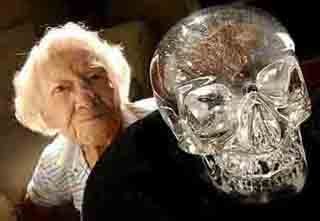
The skull was made from a single, unusually large block of clear quartz crystal, and measured 5 inches high, 7 inches long, and 5 inches wide, weighing 11 pounds, 7 ounces. It closely corresponds in size to a small human cranium, with near perfect detail, even to rendering the skull without the globular prominence or superciliary ridges, which are characteristics of a female.
As the story goes ... One day in 1927, English adventurer, traveler, and writer, F.A. "Mike" Mitchell-Hedges, who had a talent for telling colorful stories, was clearing debris from atop a ruined temple at the ancient Mayan city of Lubaantum, located in British Honduras, now Belize. His seventeen-year old daughter Anna, who had accompanied him, suddenly saw something shimmering in the dust below. Anna found an exquisitely carved and polished skull made of rock crystal, with the jaw piece missing. Three months later, she located the jaw in an excavation about 25 feet from the first site.
In 1970, art conservator and restorer Frank Dorland was given permission by the Mitchell-Hedges estate to submit the quartz skull to tests conducted at the Hewlett-Packard Laboratories at Santa Clara, California.
From these tests, and from careful studies done by Dorland himself, the skull revealed a whole array of anomalies. When submersed in a benzyl alcohol bath, with a beam of light passing through, it was noted that both the skull and jaw piece had come from the same quartz block. What was astounding to the testers, however, is they found that the skull and jaw had been carved with total disregard to the natural crystal axis in the quartz.
In modern crystallography, the first procedure is always to determine the axis, to prevent fracturing and breakage during the subsequent shaping process. Yet, the skull's maker appears to have employed methods by which such concerns were not necessary.
The unknown artist also used no metal tools. Dorland was unable to find signs of any tell-tale scratch marks on the crystal, under high-powered microscopic analysis. Indeed, most metals would have been ineffectual, for the crystal has a specific gravity of 2.65, and a Mohs hardness factor of 7. In other words, even a modern penknife cannot make a mark on it.
From tiny patterns in the quartz near the carved surfaces, Dorland determined the skull was first meticulously chiseled into a rough form, probably using diamonds. The finer shaping, grinding and polishing, Dorland believes, was done by applying innumerable applications of solutions of water and silicon-crystal sand. The big problem is, if these were the processes used, then, as Dorland calculated, it would mean that a total of 300 man-years of continuous labor was spent in making the skull. We must accept this almost unimaginable feat, or admit to the use of some form of lost technology in the skull's creation the likes of which we have no equivalent today.
The enigma of the skull, however, does not end with just its making. The zygomatic arches (the bone arch extending along the sides and front of the cranium) are accurately separated from the skull piece, and act as light pipes, using principles similar to modern optics, to channel light from the base of the skull to the eye sockets.
The eye sockets in turn are miniature concave lenses that also transfer light from a source below, into the upper cranium. Finally, in the interior of the skull is a ribbon prism and tiny light tunnels, by which objects held beneath the skull are magnified and brightened.
Richard Garvin, who authored a book about the crystal skull, believes the skull was designed to be placed over an upward shining beam. The result, with the various light transfers and prismatic effects, would illuminate the entire skull and cause the sockets to become glowing eyes. Dorland performed experiments using this technique, and reported the skull 'lights up like it was on fire.'
Still another finding about the crystal skull reveals knowledge of weights and fulcrum points. The jaw piece fits precisely onto the skull by two polished sockets, which allow the jaw to move up and down. The skull itself can be balanced exactly where two tiny holes are drilled on each side of its base, which probably once held suspending supports. So perfect is the balance at these points that the slightest breeze causes the skull to nod back and forth, the jaw opening and closing as counter-weight. The visual effect is that of a living skull, talking and articulating.
The question, of course, is what purpose did this serve? Was the skull only designed by its artist as a clever toy or conversation piece, or, as Dorland believes, was the talking skull meant to be used as an oracular device, through strange phenomena associated with the crystal skull, that defy logical explanation.
Observers have reported that, for unknown reasons, the skull will change color. Sometimes the frontal cranium clouds up, looking like white cotton, while at other times it turns perfectly clear, as if the space within disappears into an empty void. Over a period from 5 to 6 minutes, a dark spot often begins forming on the right side and slowly blackens the entire skull, then recedes and disappears as mysteriously as it came.
Other observers have seen strange scenes reflected in the eye sockets, scenes of buildings and other objects, even though the skull is resting against a black background. Still others have heard ringing noises emanating from within, and at least on one occasion, a distinct glow from no known light source surrounded the skull like an aura for up to six minutes.
The sum total of the skull appears to take in all five physical senses of the brain. It changes color and light, it emits odors, it creates sound, it gives off sensations of heat and cold to those who touch it, even though the crystal has always remained at a physical temperature of 70 degrees F under all conditions, and has even produced sensations of thirst and sometimes of taste in a few cases.
Dorland is of the opinion that what is happening in all this phenomena is that the 'crystal stimulates an unknown part of the brain, opening a psychic door to the absolute.' He observes - crystals continuously put out electric-like radio waves. Since the brain does the same thing, they naturally interact. He has found, too, that periodic happenings in the crystal skull are due to the positions of the sun, moon and planets in the sky.
Researcher Marianne Zezelic agrees that the skull was primarily used to stimulate and amplify the psychic abilities in its handlers. She wrote, Crystal serves as an accumulator of terrestrial magnetism. By gazing at the crystal, the eyes set up a harmonic relation stimulating the magnetism collected in that portion of the brain known as the cerebellum. The cerebellum therefore becomes a reservoir of magnetism which influences the quality of the magnetic outflow through the eyes, thus setting up a continuous flow of magnetism between gazer and crystal. The amount of energy entering the brain eventually increases to such a proportion as to affect the poles of the brain, a region extending just above the eyes, contributing to psychic phenomena.
Going a step further, Tom Bearden, an expert in the field of psychotronic studies, believes that, in the hands of a skilled mediator and mental focalize, the crystal skull also served not only as a vehicle to transform life field energy into electromagnetic energy and other physical effects, but also aided in healing, by the altering of its crystalline resonance to match that of a patient's mind and body frequencies, and affecting curing energies on the skull that would manifest in the patient's auric field. The skull should thus be used as an amplifier and a transmitter of psychic and earth energy forces.
When looking at the sum total of skill and knowledge incorporated in the Mitchell-Hedges skull, modern science is stumped as to how to explain it. Author Garvin summarized the findings in these words, "It is virtually impossible today, in the time when men have climbed mountains on the moon, to duplicate this achievement."
The lenses, light pipes, and prisms alone display a technical competence that the human race only achieved recently. In fact, there is no one today who could attempt to duplicate the carving.
The British Crystal Skull
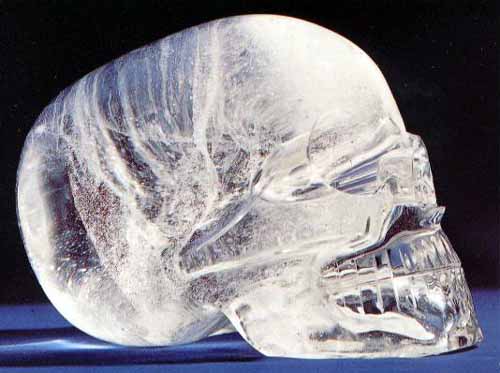
The British Crystal Skull is currently residing in the British Museum of Mankind in London and has been there since 1898. It is a one-piece clear quartz full size crystal skull.
The Paris Crystal Skull
The Paris Crystal Skull currently resides in the Trocadero Museum in Paris, France. It has a slight indentation (hole) on the top, that was cut into the skull purported to hold a something.
The public first became aware of the crystal skulls during the later part of the 19th century. At this time, many museums of the world became interested in displaying antiquities from past civilizations , Egypt, Greece, Mesoamerica, etc. Thus, in the 1878, in the Musèe de l'homme (Museum of Man in Paris) and in 1898, in the Museum of Man of London, each had a clear quartz skull on display (both came out during the 1860's during the French occupation of Mexico, purportedly found or acquired by Soldiers of Fortune, linked to Mayan sites in this country).
ET Crystal Skull
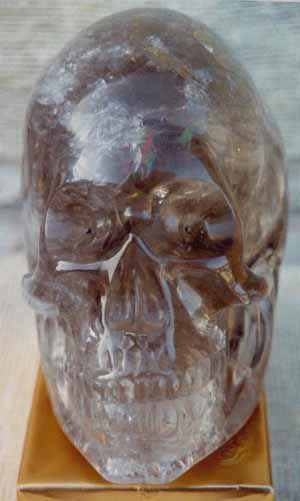
"ET" is a smoky quartz skull found in the early 20th Century in Central America. It was given its nickname because its pointed cranium and exaggerated overbite make it look like the skull of an alien being. ET is part of the private collection of Joke VanDietan, who tours with her skulls to share the healing powers she believes they possess. I did scrying with ET at the Star Knowledge Conference, June 1996.

Discuss and comment on article |
Article Link |
Source : Website
|
Return to Unexplained Mysteries
|