| |
Unexplained Mysteries : OAK ISLAND TREASURE |
|
 |
|
The Discovery of Oak island Treasure
One summer day in 1795 Daniel
McGinnis, then a teenager, was
wandering about Oak Island, Nova
Scotia (see Geography) when he came
across a curious circular depression
in the ground. Standing over this
depression was a tree whose branches
had been cut in a way which looked
like it had been used as a pulley.
Having heard tales of pirates in the
area he decided to return home to
get friends and return later to
investigate the hole.
Over the next several days McGinnis,
along with friends John Smith and
Anthony Vaughan, worked the hole.
What they found astonished them. Two
feet below the surface they came
across of layer of flagstones
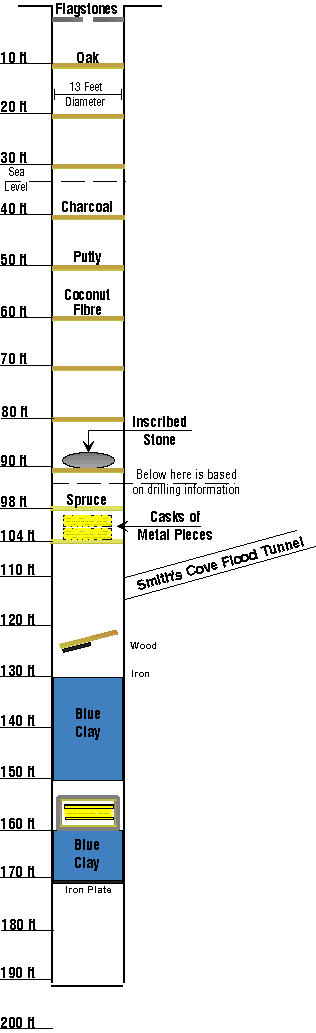
covering the pit. At 10 feet down
they ran into a layer of oak logs
spanning the pit. Again at 20 feet
and 30 feet they found the same
thing, a layer of logs. Not being
able to continue alone from here,
they went home, but with plans of
returning to search more.
It took the three discoverers 8
years, but they did return. Along
with The Onslow Company, formed for
the purpose of the search, they
began digging again. They quickly
got back to 30 foot point that had
been reached 8 years ago. They
continued down to 90 feet, finding a
layer of oak logs at every 10 foot
interval. Besides the boards, at 40
feet a layer of charcoal was found,
at 50 feet a layer of putty, and at
60 feet a layer of coconut fiber.
At 90 feet one of the most puzzling
clues was found - a stone inscribed
with mysterious writing. After
pulling up the layer of oak at 90
feet and continuing on, water began
to seep into the pit. By the next
day the pit was filled with water up
to the 33 foot level. Pumping didn't
work, so the next year a new pit was
dug parallel to the original down to
100 feet. From there a tunnel was
run over to The Money Pit. Again the
water flooded in and the search was
abandoned for 45 years.
The Booby Trap
As it turns out, an ingenious booby
trap had been sprung. The Onslow
Company had inadvertently unplugged
a 500 foot waterway that had been
dug from the pit to nearby Smith's
Cove by the pit's designers. As
quickly as the water could be pumped
out it was refilled by the sea. This
discovery however is only a small
part of the intricate plan by the
unknown designers to keep people
away from the cache. In 1849 the
next company to attempt to extract
the treasure, The Truro Company, was
founded and the search began again.
They quickly dug down to 86 feet
only to be flooded. Deciding to try
to figure out what was buried before
attempting to extract it, Truro
switched to drilling core samples.
The drilling produced some
encouraging results.
First Hints of Treasure
At 98 feet the drill went through a
spruce platform. Then it encountered
4 inches of oak and then 22 inches
of what was characterized as "metal
in pieces""; Next 8 inches of oak,
another 22 inches of metal, 4 inches
of oak and another layer of spruce.
The conclusion was that they had
drilled through 2 casks or chests
filled will coins. Upon pulling out
the drill they found splinters of
oak and strands of what looked like
coconut husk.
One account of the drilling also
mentions that three small gold
links, as from a chain, were brought
up. Unfortunately no one knows where
they have gone. Interestingly, the
earth encountered beneath the bottom
spruce platform was loose indicating
that the pit may have gone even
deeper. A later group of searchers
would find out how much deeper.
The Truro Company returned in 1850
with plans to dig another parallel
hole and then tunnel over to the
Money Pit. Just like before, as they
tunneled over, water began to rush
in. They brought in pumps to try to
get rid of the water but it was
impossible to keep the water out.
During the pumping someone noticed
that at Smith's Cove during low tide
there was water coming OUT of the
beach. This find lead to an amazing
discovery - the beach was
artificial.
Artificial Beach
It turns out that the pit designers
had created a drain system, spread
over a 145 foot length of beach,
which resembled the fingers of a
hand. Each finger was a channel dug
into the clay under the beach and
lined by rocks. The channels were
then filled with beach rocks,
covered with several inches of eel
grass, and then covered by several
more inches of coconut fiber. The
effect of this filtering system was
that the channels remained clear of
silt and sand while water was still
allowed to flow along them. The
fingers met at a point inland where
they fed sea water into a sloping
channel which eventually joined the
Money Pit some 500 feet away. Later
investigations showed this
underground channel to have been 4
feet wide, 2 1/2 feet high, lined
with stone, and meeting the Money
Pit between the depths of 95 to 110
feet.
To the Truro Company, the answer was
now simple - just block off the
water flow from the beach and dig
out the treasure. Their first
attempt was to build a dam just off
the beach at Smith's Cove, drain the
water, and then dismantle the drain
channels. Unfortunately a storm blew
up and destroyed the dam before they
could finish. An interesting note:
the remains of an older dam were
found when building the new one.
The next plan was to dig a pit 100
feet or so inland in the hopes of
meeting with the water channel
underground at which point they
could plug the channel. This scheme
too failed. And this was the last
attempt by the Truro company to
uncover the secrets of Oak Island.
From WIkipedia :
Oak Island is a 140-acre (57 ha) island in Lunenberg County on the south shore of Nova Scotia, Canada. The tree-covered island is one of about 360 small islands in Mahone Bay and rises to a maximum of 35 feet (11 m) above sea level.
Oak Island is noted as the location of the so-called Money Pit, a site of numerous excavations to recover treasure believed by many to be buried there. Despite great effort and expense, no treasure has been found, and skeptics have dismissed it as a sinkhole and natural cavities.
The island is privately owned, and advance permission is required for any visitation.
History of the Money Pit
Early accounts
There are many 19th-century accounts of Oak Island, but they are conflicting, not contemporary, and not impartial. Further, physical evidence from the initial excavations is absent or has been lost.
In 1795, 16-year-old Daniel McGinnis discovered a circular depression in a clearing on the southeastern end of the island with an adjacent tree which had a tackle block on one of its overhanging branches. McGinnis, with the help of friends John Smith and Anthony Vaughan, excavated the depression and discovered a layer of flagstones a few feet below. On the pit walls there were visible markings from a pick. As they dug down they discovered layers of logs at about every ten feet (3 m). They abandoned the excavation at 30 feet (10 m). This initial discovery and excavation was first mentioned in print in the Liverpool Transcript in October, 1856. More 19th-century accounts followed in the Liverpool Transcript, the Novascotian, British Colonist, and A History Of Lunenburg County (however, the latter account was based on the earlier Liverpool Transcript articles and does not represent an independent source).
About eight years after the 1795 dig, according to the original articles and the memories of Vaughan, another company examined what was to become known as the Money Pit. The Onslow Company sailed 300 nautical miles (560 km) from central Nova Scotia near Truro to Oak Island with the goal of recovering what they believed to be secret treasure. They continued the excavation down to approximately 90 feet (27.43 m) and found layers of logs or "marks" about every ten feet (3 m) and layers of charcoal, putty and coconut fibre at 40, 50 and 60 feet (12, 15 and 18 m).
According to one of the earliest written accounts, at 80 or 90 feet (27 m), they recovered a large stone bearing an inscription of symbols. Several researchers are said to have attempted to decipher the symbols. One translated them as saying: "forty feet below, two million pounds lie buried." No photographs, drawings, or other images of the stone are known to have been produced prior to its claimed disappearance circa 1912. The symbols currently associated with the "forty feet down..." translation and seen in many books first appeared in True Tales of Buried Treasure, written by explorer and historian Edward Rowe Snow in 1951. In this book he claims he was given this set of symbols by one Reverend A.T. Kempton of Cambridge, Massachusetts.[10] Nothing more is known about Kempton's involvement in the Oak Island tale.
The pit subsequently flooded up to the 33-foot (10 m) level. Bailing did not reduce the water level, and the excavation was abandoned.
Investors formed The Truro Company in 1849, which re-excavated the shaft back down to the 86-foot (26 m) level, where it flooded again. They then drilled into the ground below the bottom of the shaft. According to the nineteenth-century account, the drill or "pod auger" passed through a spruce platform at 98 feet (30 m), a 12-inch head space, 22 inches (560 mm) of what was described as "metal in pieces", 8 inches (200 mm) of oak, another 22 inches (560 mm) of metal, 4 inches (100 mm) of oak, another spruce layer, and finally into clay for 7 feet without striking anything else.
Oak Island Association and Old Gold Salvage group years
The next excavation attempt was made in 1861 by a new company called the Oak Island Association which resulted in the collapse of the bottom of the shaft into either a natural cavern or booby trap underneath. The first fatality during excavations occurred when the boiler of a pumping engine burst.[11] The company gave up when their funds were exhausted in 1864.
Further excavations were made in 1866, 1893, 1909, 1931, 1935, 1936, and 1959, none of which were successful. Another fatality occurred in 1887, when a worker fell to his death.[11] (Six people have been killed in accidents during various excavations.) Franklin Roosevelt was part of the Old Gold Salvage group of 1909 and kept up with news and developments for most of his life.
Gilbert Hedden and William Chappell years
In 1928, a New York newspaper printed a feature story about the strange history of the island. Gilbert Hedden, operator of a steel fabricating concern, saw the article and was fascinated by the engineering problems involved in recovering the putative treasure. Hedden collected books and articles on the island and made six trips there. He even ventured to England to converse with Harold Tom Wilkins, the author of Captain Kidd and His Skeleton Island, believing he had found a link between Oak Island and a map in Wilkins's book.
The very wealthy Hedden then purchased the southeast end of the island. He did not start digging until the summer of 1935, following excavations by William Chappell in 1931. In 1939, he even informed King George VI of England about developments on Oak Island.
The 1931 excavations by William Chappell sank a 163-foot (50 m) shaft 12x14 feet to the southwest of what he believed was the site of the 1897 shaft, close to the original pit. At 127 feet (39 m), a number of artifacts, including an axe, an anchor fluke, and a pick were found. The pick has been identified as a Cornish miner's poll pick. By this time, the entire area around the Money Pit was littered with the debris and refuse of numerous prior excavation attempts, so exactly to whom the pick belonged is unverifiable.
Restall family and Robert Dunfield years
Excavation by the Restall family in the early 1960s ended tragically when four men died after being overcome by fumes in a shaft near the beach. In 1965, Robert Dunfield leased the island and, using a 70-ton digging crane with a clam bucket, dug out the pit area to a depth of 134 feet (41 m) and width of 100 feet (30 m). The removed soil was carefully inspected for artifacts. Transportation of the crane to the island required the construction of a causeway (which still exists) from the western end of the island to Crandall's Point on the mainland two hundred meters away.
Triton Alliance years
Around 1967, Daniel C. Blankenship and David Tobias formed Triton Alliance, Ltd. and purchased most of the island. In 1971, Triton workers excavated a 235-foot (72 m) shaft supported by a steel caisson to bedrock. According to Blankenship and Tobias, cameras lowered down the shaft into a cave below recorded the presence of some chests, human remains, wooden cribbing and tools; however, the images were unclear, and none of these claims have been officially confirmed. The shaft subsequently collapsed, and the excavation was again abandoned. This shaft was later successfully re-dug to 181 feet (55 m), reaching bedrock; work was halted due to lack of funds and the collapse of the partnership.
The Money Pit mystery was the subject of an episode of the television series In Search of..., which first aired January 18, 1979, bringing the legend of Oak Island to a wider audience. Previously, the story had only been known among locals, treasure hunting groups, and readers of sensational magazines and anthologies.
During the 1990s, further exploration was stalled due to legal battles between the Triton partners. As of 2005, a portion of the island was for sale with an estimated price tag of $7 million. A group called the Oak Island Tourism Society had hoped the Government of Canada would purchase the island, but a group of American businessmen in the drilling industry did so instead.
After Triton
It was announced in April 2006 that partners from Michigan had purchased a 50 percent stake in Oak Island Tours Inc. for an undisclosed amount of money. The shares sold to the Michigan partners were previously owned by David Tobias; remaining shares are owned by Blankenship. Center Road Developments, in conjunction with Allan Kostrzewa, a member of the Michigan group, had purchased Lot 25 from David Tobias for a reported $230,000 one year previous to Tobias selling the rest of his share. The Michigan group, working with Blankenship, has said it will resume operations on Oak Island in the hope of discovering buried treasure and the mystery of Oak Island.
Treasure theories
There has been wide-ranging speculation as to who originally dug the pit and what it might contain. Later accounts claim that oak platforms were discovered every 10 feet, but the earliest accounts simply say that "marks" of some type were found at these places. They also claim there were "tool marks" or pick scrapes on the walls on the money pit and that the dirt was noticeably loose and not as hard packed as the surrounding soil. One expedition claimed to have found the flood tunnel at 90 feet, and that it was lined with flat stones. However Robert Dunfield (a trained geologist) wrote that he carefully examined the walls of the re-excavated pit and was unable locate any evidence of this tunnel. The five box drains made from flat stones did exist and were identified and recorded by the Restalls.
Pirate treasure
The cipher stone, which one researcher is said to have translated to read "Forty feet below two million pounds are buried", was allegedly last seen in the early 20th century (exact dates are a topic of controversy). Some accounts state that Smith used it as a fireback in his fireplace, while others claim it was last seen as a doorstep in a Halifax bookbinder's shop. The accuracy of the translation, whether the symbols as commonly depicted are accurate, or if they meant anything at all, remains disputed. Some believe the pit holds a pirate treasure hoard buried by Captain Kidd or possibly Edward Teach (Blackbeard), who claimed he buried his treasure "where none but Satan and myself can find it."
Some also hold to the theory that Kidd conspired with Avery and Oak Island was used as a pseudo community bank between the two.
Man made structures under Oak Island do in fact exist as discussed in many books, including a book written by Lee Lamb, daughter of Robert Restall.[16] Whether these structures are the remains of prior excavation attempts or artifacts left behind by those who allegedly built the Money Pit are unknown. It is known that several documented post-1860 treasure recovery attempts, as described above, ended in collapsed excavations and flooding.
Naval treasure
Others agree it was dug to hold treasure, but believe this was done by someone other than pirates, such as Spanish sailors from a wrecked galleon or British troops during the American revolution. John Godwin argued that, given the apparent size and complexity of the pit, it was likely dug by French army engineers hoping to hide the contents of the treasury of the Fortress of Louisbourg after it fell to the British during the French and Indian War.
Marie Antoinette's jewels
There is a story, like most others regarding the island, that lacks adequate archival sources, or any quoted sources at all, which places the priceless jewels of Marie Antoinette (which are historically missing, save for some specimens in the collections of museums worldwide) on Oak Island. During the French Revolution, when the Palace of Versailles was stormed by revolutionaries in 1789, Marie Antoinette instructed her maid or a lady-in-waiting to take her prized possessions and flee. Supposedly, this maid fled to London with such royal items as Antoinette's jewels and perhaps other treasures, such as important artwork or documents, secreted away either on her person (one variation suggests sewn into her underskirts in the case of the jewels, though fails to mention artwork) or as her luggage; it is even said she was perhaps assisted by the remaining officers of the French navy during the uprising at the queen's behest.
The story then goes on to say that this woman fled further afield from London to Nova Scotia and through the royal connections she would have had during her service to the queen at Versailles, managed to contract the French navy to help construct the famed 'pit' on the island. This theory, as noted, lacks recognized documentation other than that which is folkloric in nature, involves the French navy, which, during the Revolution had an uncertain level of authority, and would place the construction of the Oak Island structure very close to its initial discovery by Daniel McGinnis in 1795. Whether such a complex engineering effort could have been completed in that small space of time is questionable, though no official date of its construction exists. However, other theories do suggest the structure is French and naval in style.
Exotic treasure
Still others have speculated that the Oak Island pit was dug to hold treasure much more exotic than gold or silver. In his 1953 book, The Oak Island Enigma: A History and Inquiry Into the Origin of the Money Pit, Penn Leary claimed that English philosopher Francis Bacon used the pit to hide documents proving him to be the author of William Shakespeare's plays,[18] a theory recently used in the Norwegian book Organisten (The Organ Player) by Erlend Loe and Petter Amundsen. It has even been asserted that the pit might have been dug by exiled Knights Templar, and that it is the last resting place of the Holy Grail.

Submit News/Videos/Links |
Discuss article |
Article Link
|
More unsolved mysteries on Unexplained Mysteries
|
